Extra exam question E7G09
Subelement E7, PRACTICAL CIRCUITS· Group E7G
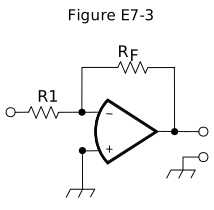
What will be the output voltage of the circuit shown in Figure E7-3 if R1 is 1,000 ohms, RF is 10,000 ohms, and 0.23 volts DC is applied to the input?
- A.0.23 volts
- B.2.3 volts
- C.-0.23 volts
- D.-2.3 volts (correct answer)
WhyThe circuit in Figure E7-3 with R1 at 1,000 ohms, RF at 10,000 ohms, and 0.23 volts DC applied to the input produces an output voltage of -2.3 volts. In the Figure E7-3 inverting amplifier, output voltage equals negative RF divided by R1, times the input voltage: negative 10,000 divided by 1,000, or negative 10, times 0.23 volts works out to negative 2.3 volts, answer D. The gain magnitude alone (2.3 volts) without the sign, or the raw unamplified input voltage, don't reflect both the actual amplification and the phase inversion this inverting configuration applies.
Published 2026-08-28 · Last updated 2026-08-28 · Question text is verbatim from the 2024-2028 NCVEC Element 4 pool (public domain); the explanation above is original writing, see our methodology.
Related questions
- E7G01What is the typical output impedance of an op-amp?
- E7G02What is the frequency response of the circuit in E7-3 if a capacitor is added across the feedback resistor?
- E7G03What is the typical input impedance of an op-amp?
- E7G04What is meant by the term “op-amp input offset voltage”?
- E7G05How can unwanted ringing and audio instability be prevented in an op-amp audio filter?